Haptics '26
Seeking a Summer 2027 research internship
Hi, I'm Michael.I make touch programmable,
Hi, I'm Michael.I make touch programmable,
for people and for robots.
I’m a Computer Science Ph.D. student at USC, working with Prof. Heather Culbertson in the HaRVI Lab. I study how to represent touch so that one model can both render it for humans and use it for robot learning. On the human side, I generate haptic textures from language, video, and 3D scenes, and build teleoperation systems that let you feel what the gripper feels. On the robot side, I learn tactile representations from vision-based touch, force, and vibration, trained on what a person would actually perceive, so robots can anticipate slip and manipulate by feel.
News
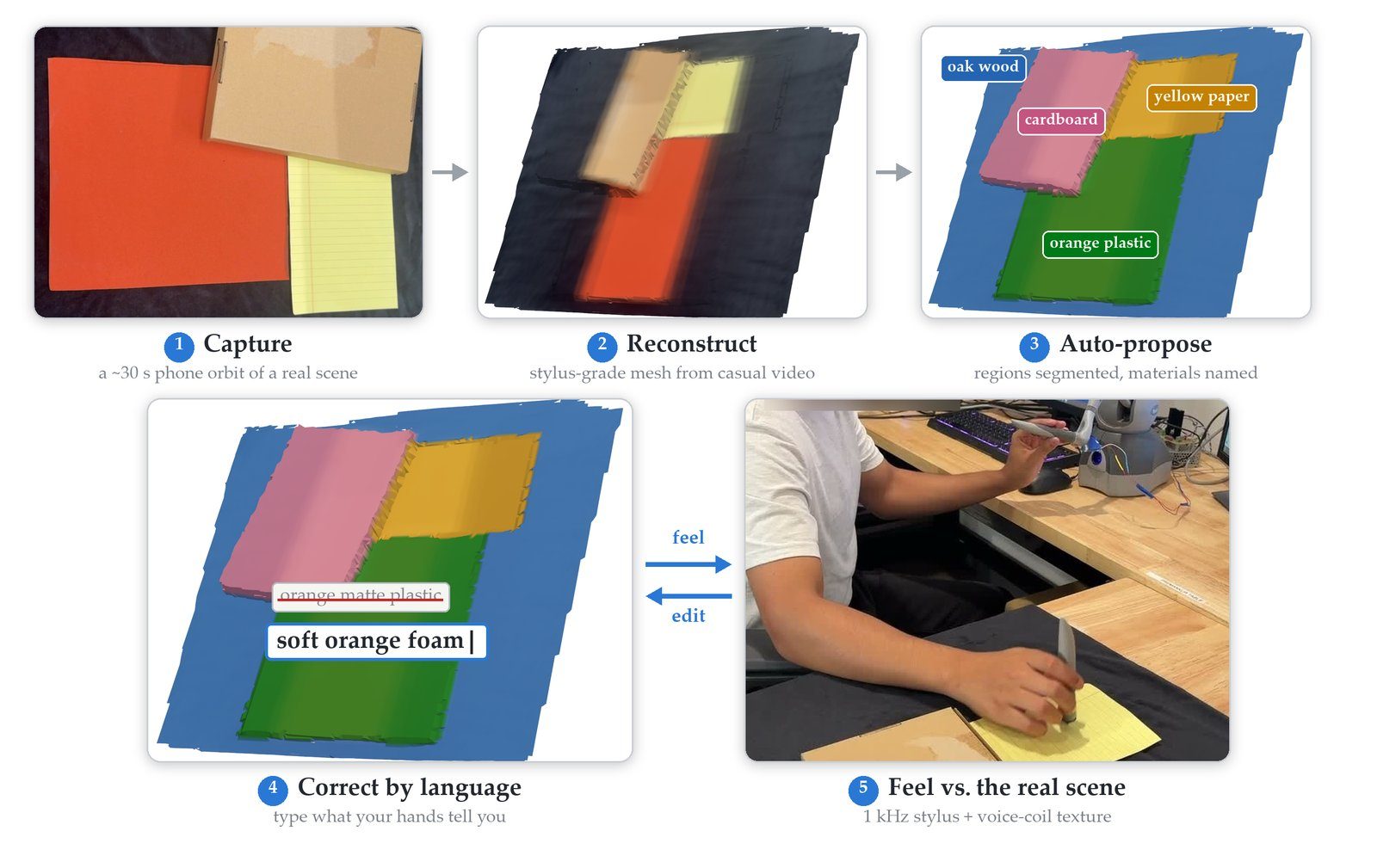
TouchTwin, a system for turning phone scans into touchable, editable haptic scenes, was submitted to CHI 2027.
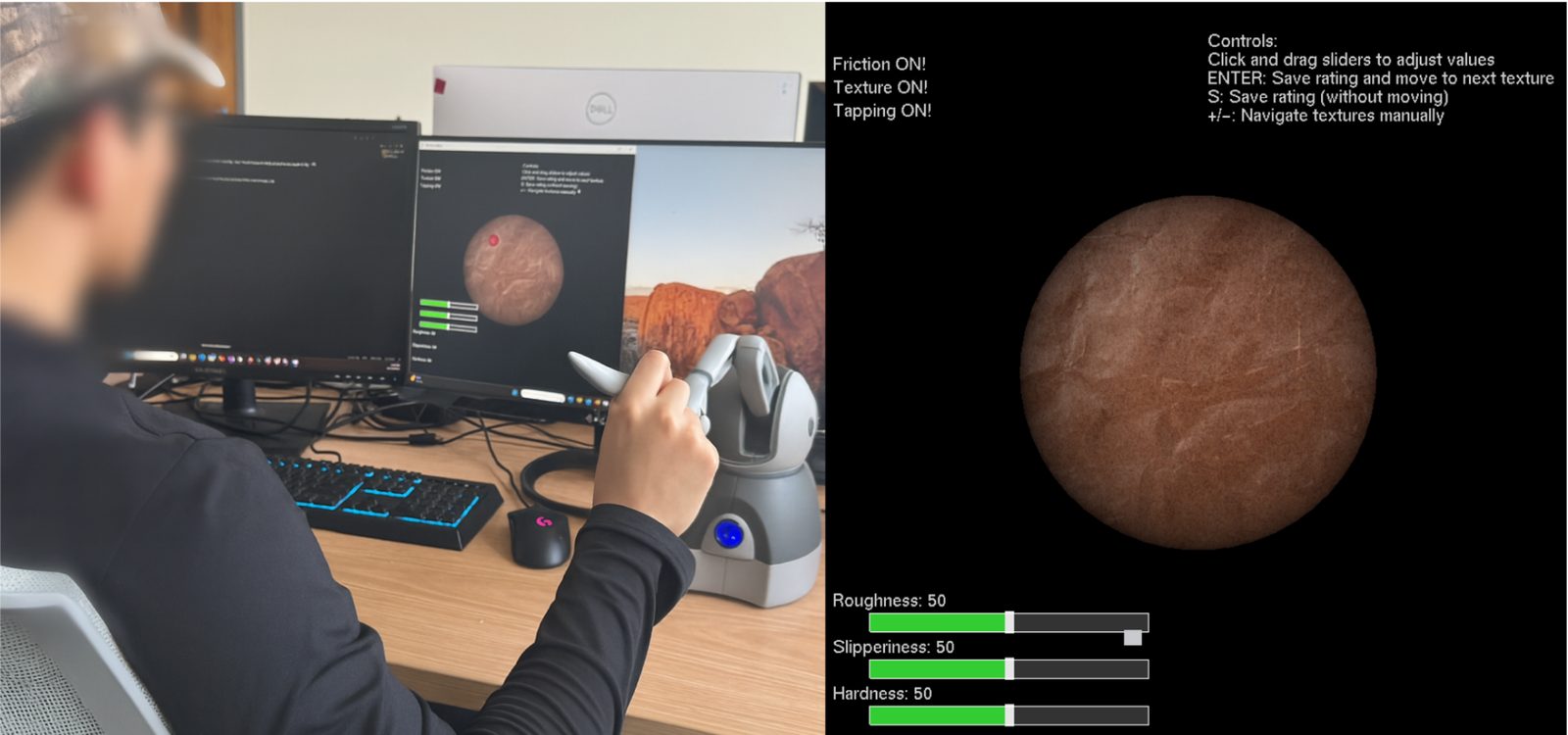
Language-guided texture authoring received a Distinguished Paper Award (Technical Long Paper) at IEEE Haptics Symposium 2026.
Shape n’Swarm, generative authoring with swarm UIs and LLMs, appeared at ACM UIST 2025.
Featured by Spectrum News NY1 in “Majoring in Artificial Intelligence.”
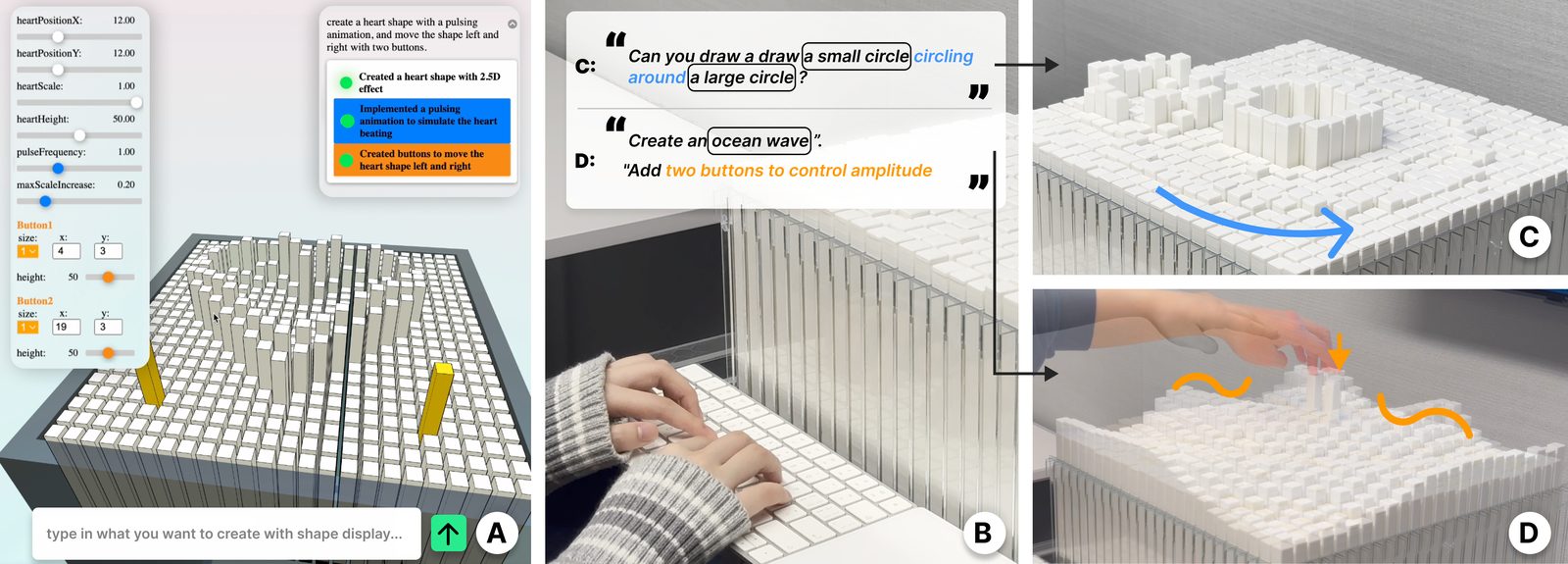
SHAPE-IT, text-to-shape-display with LLMs, appeared at ACM UIST 2024.
Selected research
All projects →Publications
Google Scholar →UIST '25
UIST '24
ICRA '22
JSTARS '22
Weakly Supervised Part-Based Method for Combined Object Detection in Remote Sensing Imagery
Under review
CHI '27
TouchTwin: Human–AI Haptic Authoring for 3D-Scanned Tabletop Scenes through Language and Touch
About
Path so far
- 2024–nowUniversity of Southern CaliforniaPh.D., Computer Science · HaRVI Lab
- 2022–2024University of ChicagoPredoctoral M.S. · AxLab with Prof. Ken Nakagaki
- 2022KolmostarSoftware Engineer Intern
- 2021–2022Georgia Tech Borg LabLab Assistant · robot drawing and writing
- 2018–2022Georgia Institute of TechnologyB.S., Computer Science
- 2019MegviiRobotics Software Solution Intern
What I work on
How touch should be represented so that people can feel it and robots can learn from it. Right now that means language-driven haptic textures, touchable twins of scanned scenes, teleoperation with tactile feedback, and tactile representations for robot manipulation, grounded in measured materials in simulation.
Haptic renderingTactile perceptionRobot learningTeleoperationHCIVR/AR
Read my research statement
My research asks how touch should be represented so that the same signal means something to both people and robots. Contact reaches us as force, vibration, motion, and deformation unfolding over time. I study how to capture these signals, how to structure them, and how to use them in two directions: rendering them so people can feel them, and learning from them so robots can act on them.
On the rendering side, I build on data-driven texture rendering to generate haptic signals from language and video. I also build authoring tools that let people paint feelable textures onto 3D content and touch scanned scenes. The aim is to make tactile experience something people can describe, edit, and share, not just record.
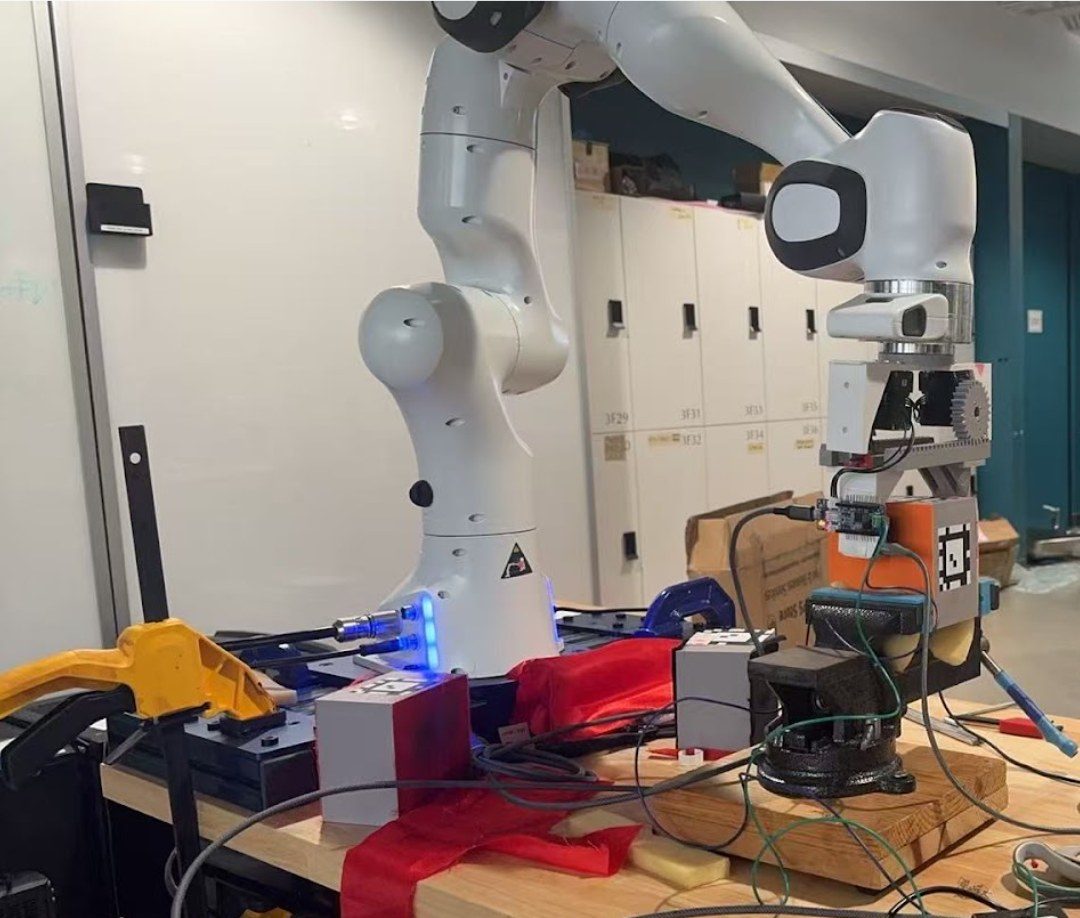
In teleoperation, I estimate contact state at the robot gripper, including normal force, sliding velocity, and surface texture. I render that state back to the operator through a vibrotactile glove, so they feel what the gripper feels and can control it more precisely.
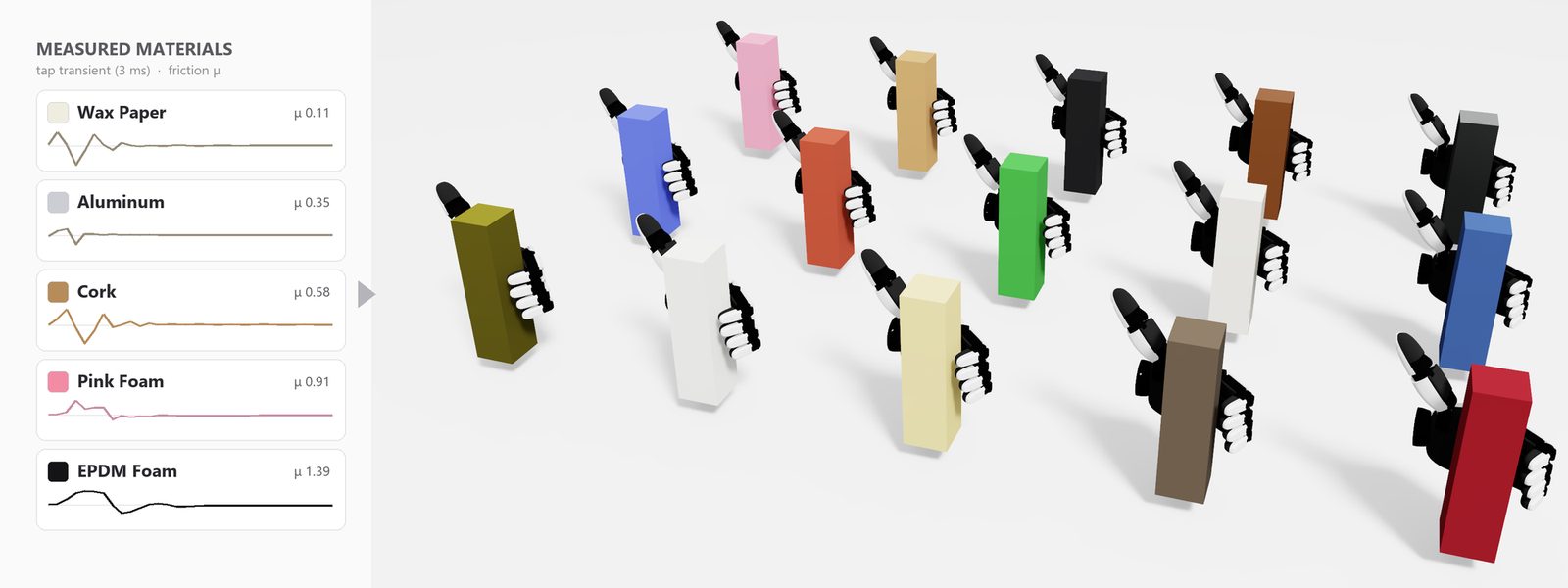
These two lines meet in my current work on tactile representations for manipulation. I train temporal encoders on vision-based tactile, force, and vibration data, supervised by perceptual rendering: a representation is judged by whether it can reproduce what a person would feel. My hypothesis is that this captures the temporal structure of contact that frame-level tactile self-supervised learning misses, such as slip onset, stick-slip, and texture during sliding. If so, one representation can drive both haptic feedback and slip-anticipating manipulation. To scale the approach, I pair real sensor data with measured materials in simulation, so the same contact can be replayed and generated across sim and real.
My long-term goal is touch as a programmable medium: a shared representation that lets robots perceive by feel and lets people author, transmit, and experience touch. The applications span teleoperation, design, accessibility, and embodied AI.
Toolbox
3D Systems Touch1 kHz force feedback
GelSight Minivision-based tactile
Franka FR37-DoF arm
XHAND1dexterous hand
Weart glovevibrotactile rendering
Isaac Labrobot learning sim
CLIPtext embeddings
Stable Diffusionvisual previews
SAM 2segmentation
VGGT3D reconstruction
Unityshape displays
Pythoneverything else
Teaching and service
- Teaching assistant · CSCI 445 Introduction to Robotics, USC (2025) · CMSC 25040 Introduction to Computer Vision, UChicago (2023)
- Reviewer · CHI, UIST, IEEE Haptics Symposium, IEEE Transactions on Haptics
- Mentor · USC CURVE, Viterbi SURE, and REU students
Life